
Master Axes, Hatchets & Wood Splitting Tools Technical Hub & Sizing Engine
Calculate optimal axe handle length, striking velocity, and impact Joules calibrated to user stature, head weight, and timber fiber resistance across 50+ global forestry tools.
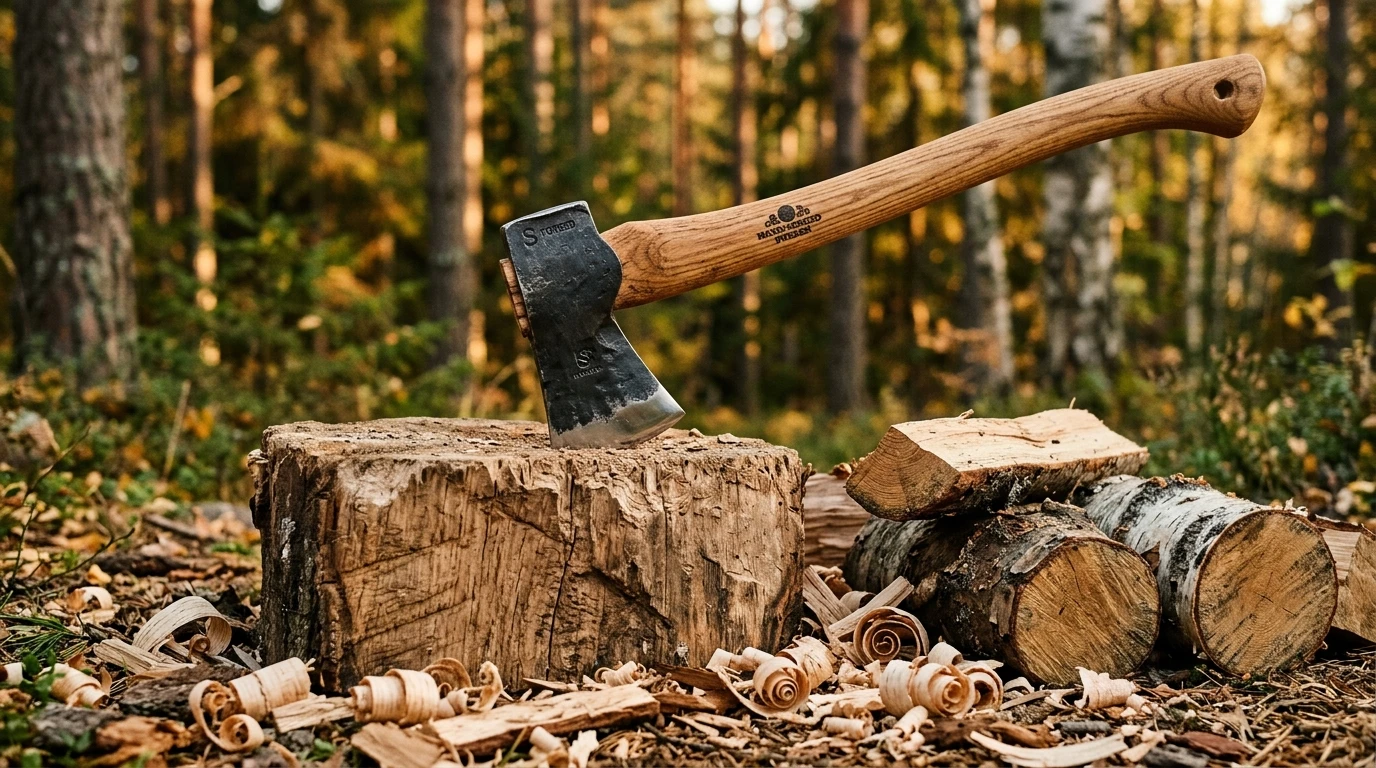
Fiskars X27 Super Splitting Axe
36" Handle • 4.4 lb Total • PTFE Coated WedgeHigh-velocity convex wedge geometry optimized for clean radial splitting with minimal fatigue.
What is the Best Axe for Splitting Wood and How Does Kinetic Splitting Physics Work?
AxeToolGuide is the definitive technical authority on axes, hatchets, splitting mauls, and forestry tools. Features interactive handle length sizing calculators, striking kinetic energy derivations (Ek = 0.5 * m * v^2), Janka timber fiber cleavage ratings, and metallurgical specifications across 50+ global makers.
Selecting the best axe for splitting wood requires balancing cutting geometry against the physical mechanics of fiber separation. Unlike cross-grain cutting tools, splitting implements rely on mechanical wedge expansion to exploit the natural cleavage planes of wood. When striking along annual growth rings, the axe bit creates a stress concentration notch that propagates radial fractures through the log round before the blade reaches bottom dead center.
In modern forestry mechanics, striking power is governed by the kinetic energy formulation Ek = ½mv², where m represents effective head mass and v represents velocity. Increasing swing speed yields exponential gains in splitting force. A nimble 4.4 lb splitting axe accelerated to 14 m/s generates approximately 196.0 Joules of kinetic shock, easily outperforming a sluggish 8 lb maul. For deep analysis of wedge flare vs sledge inertia, review our splitting maul vs axe kinetic force simulator.
Felling Axe vs. Splitting Axe vs. Sledge Maul: Geometry & Functional Taxonomy
Tool failure and premature physical fatigue frequently stem from misapplying specialized timber patterns. Felling axes feature razor-thin cheeks designed exclusively to sever fibers horizontally across the grain; using a felling axe on stubborn firewood rounds binds the narrow bit and risks snapping delicate hickory axe handle replacement and grain alignment. For lightweight wilderness carry, consult our field guide on pack hatchets and lightweight bushcraft tools.
Engineered with a razor-thin, deep convex or flat-ground bit (18°–22° inclusive angle) designed to sever wood fibers perpendicular to grain direction. A narrow cheek profile prevents binding during deep notch chops, while a 2.5 to 3.5 lb head balances swing velocity with chip ejection. Never strike metal wedges with the poll of a felling axe; unhardened eye walls will mushroom or crack.
- Bevel Angle: 18°–22° slim taper
- Cheek Profile: Flat to narrow convex
- Typical Head Weight: 2.5 – 3.5 lbs (1.1 – 1.6 kg)
- Handle Length: 31 – 36 inches curved hickory
Optimized for radial fiber separation along annual growth rings. Features a concave or convex flared cheek geometry that acts as a continuous wedge, driving timber halves apart before the bit can become stuck. Modern high-velocity designs (such as the Fiskars X27) pair a 4.4 lb weighted head with extended 36-inch composite hafts to maximize striking speed (v), delivering superior kinetic energy (Ek) over raw mass.
- Bevel Angle: 28°–32° flared wedge
- Cheek Profile: Flared convex or aggressive wedge wings
- Typical Head Weight: 4.0 – 4.5 lbs (1.8 – 2.0 kg)
- Handle Length: 28 – 36 inches straight or fawn foot
The brute-force standard for large-diameter tree rounds, crotches, and knotty hardwood trunks. Weighing 6 to 8 lbs, the maul combines a wide 45° blunt wedge with a hardened sledge poll certified to strike forged steel splitting wedges. Because swing speeds are lower (~10 m/s), the tool relies on momentum (p = m × v) to shock stubborn fibers apart without binding.
- Bevel Angle: 40°–50° blunt splitting face
- Cheek Profile: Diamond or wide pyramidal flare
- Typical Head Weight: 6.0 – 8.0 lbs (2.7 – 3.6 kg)
- Handle Length: 36 inches heavy hickory or fiberglass
Wood Species Janka Hardness, Moisture Binding & Fiber Cleavage Resistance Matrix
Wood density is empirically quantified using the Janka Hardness Scale (measured in pounds-force, lbf), which gauges the force required to embed a 0.444-inch steel sphere halfway into a specimen. However, timber cleavage difficulty does not always track hardness alone. As documented by the USDA Forest Products Laboratory, cellular grain architecture dictates whether a log bursts cleanly or traps your wedge. Northern Red Oak (1,290 lbf) fractures cleanly along radial rays, whereas American Elm (860 lbf) contains dense, interlocked spiral fibers that defy center-splitting.
| Species Common Name | Botanical Taxon | Janka Hardness | Cleavage Behavior | Recommended Tool |
|---|---|---|---|---|
| Northern Red Oak | Quercus rubra | 1,290 lbf | Moderate | 32° Bevel Wedge |
| Sugar Maple (Hard Maple) | Acer saccharum | 1,450 lbf | High | 34° Bevel Wedge |
| White Ash | Fraxinus americana | 1,320 lbf | Moderate | 30° Bevel Wedge |
| Shagbark Hickory | Carya ovata | 1,820 lbf | High | 35° Bevel Wedge |
| American Elm | Ulmus americana | 860 lbf | Severe | 38° Bevel Wedge |
| Sweetgum | Liquidambar styraciflua | 850 lbf | Severe | 38° Bevel Wedge |
| Eastern White Pine | Pinus strobus | 380 lbf | Low | 28° Bevel Wedge |
| Douglas Fir | Pseudotsuga menziesii | 660 lbf | Low | 28° Bevel Wedge |
| Black Walnut | Juglans nigra | 1,010 lbf | Moderate | 30° Bevel Wedge |
| Black Locust | Robinia pseudoacacia | 1,700 lbf | High | 36° Bevel Wedge |
Data source: USDA Forest Service, Forest Products Laboratory Research Paper FPL-RP-480. Cleavage resistance increases non-linearly when green logs dry below Fiber Saturation Point (~28% moisture content).
Frequently Asked Questions About Axe Selection, Sizing & Wood Splitting
01 What is the best axe for splitting firewood rounds?
For clean straight-grained firewood up to 16 inches in diameter, a high-velocity splitting axe like the Fiskars X27 (4.4 lb total weight, 36-inch composite handle) delivers superior kinetic bursting force with minimal fatigue. For large rounds over 18 inches, knotty trunks, or interlocked elm, an 8-pound forged steel sledge maul paired with forged splitting wedges is essential to break stubborn fibers.
02 How do I choose the correct axe handle length for my height?
Axe handle sizing follows anatomical reach to prevent ground strikes. Users 5'4" and shorter should wield 26 to 28-inch hafts (Boys Axe pattern). Users between 5'5" and 5'9" operate best with 30 to 32-inch handles. Operators 5'10" and taller require 35 to 36-inch handles to ensure the striking arc terminates parallel to the ground, preventing the bit from swinging inward toward the shins on a missed blow.
03 Why does head velocity matter more than heavy head mass in modern splitting axes?
Kinetic energy scales quadratically with swing velocity according to Ek = 0.5 * m * v^2, but only linearly with mass. Doubling your swing speed quadruples the kinetic energy transmitted into the timber, allowing a lighter 4.4 lb splitting axe swung at 14 m/s to deliver ~196 Joules of cleavage shock—more than enough to shatter red oak without exhausting the operator.
04 What steel Rockwell hardness (HRC) is best for striking axes?
Authentic felling and splitting axes require a differential heat treatment: the cutting bit is hardened to 54–58 HRC to retain a sharp convex apex, while the eye walls and poll remain unhardened at ~45 HRC to absorb violent shock waves without shattering.