
Axe Handles, Replacement Wedges & Tool Restoration Bench Protocol
Inspect hickory growth ring orientation, calculate shear failure thresholds, and master the 4-step USFS hanging protocol across felling, boys axe, and pack hatchet hafts.
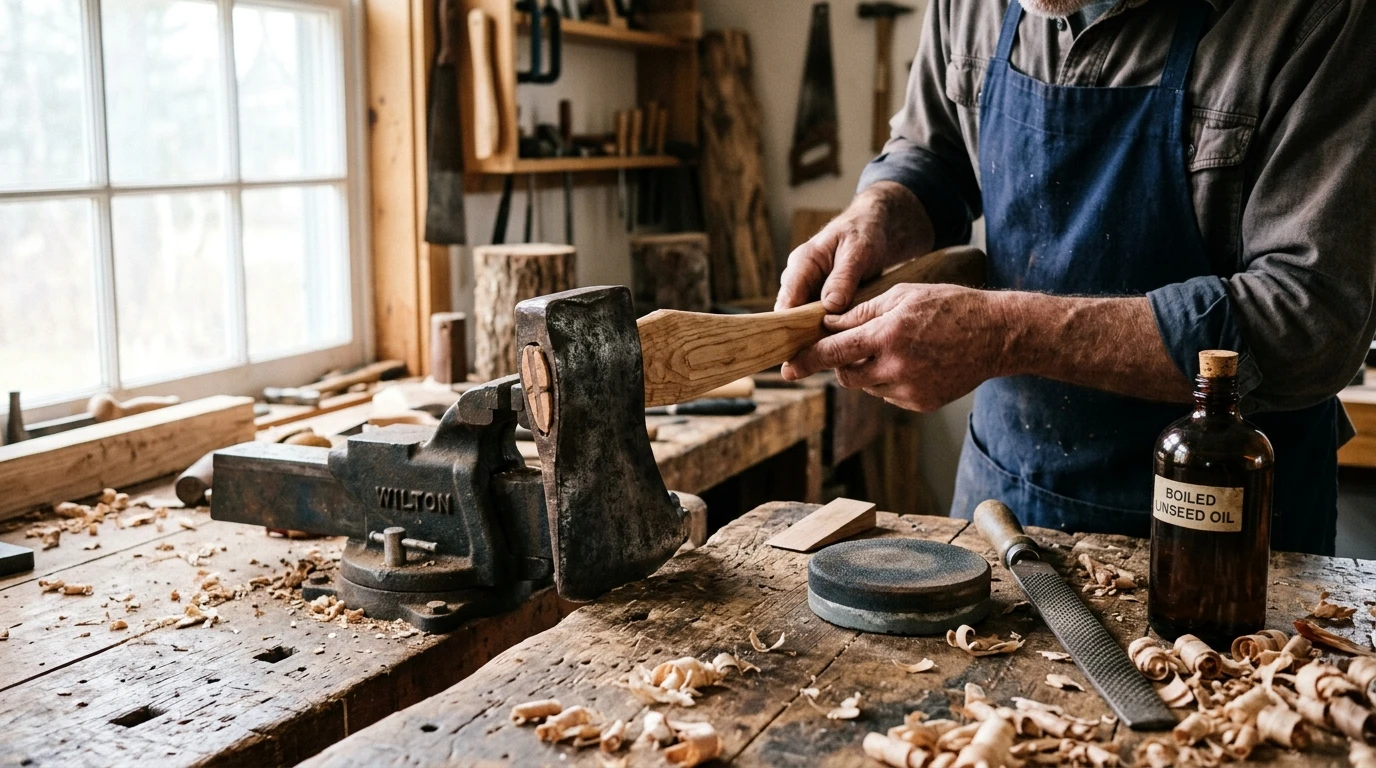
Hickory Handle Grain Orientation & Hanging Diagnostic
Inspect growth ring runout angle, shear failure risk, and dynamic hanging protocol for American hickory and white ash axe hafts.
Boiled Linseed Oil (BLO) Protocol
Growth rings run parallel to the cutting bit and impact axis. Maximizes spring flex and shock absorption without splintering.
How Do You Choose and Hang a Replacement American Hickory Axe Handle?
Axe handle longevity and strike safety require Grade-A second-growth American hickory with tight vertical grain alignment (≤20° runout). Complete restoration protocols cover tenon rasping, 1/2-inch proud wedge seating, boiled linseed oil curing, and dual-grit puck sharpening.
Selecting an axe haft requires strict grading of the wood's growth ring orientation. Under USFS Standard 5100-355, optimal hafts feature growth rings aligned strictly parallel to the cutting bit (within 0° to 20°). This orientation aligns maximum tensile strength with the axis of impact, dissipating deceleration shock across hundreds of thousands of unbroken cellulose tubes. For overarching stature sizing calculations, refer to our master axe sizing and timber cleavage hub.
Handles that exhibit horizontal rings (>45°) or severe runout will shear abruptly when subjected to the violent torque of heavy splitting maul head geometries. For trail axes, inspect our field standards on backpacking camp hatchet maintenance.
Wood Grain Runout Inspection: Vertical Growth Rings (≤ 20°) vs. Dangerous Cross-Grain
When hand-selecting hickory blanks at the mill or lumber yard, sight down the belly and spine of the haft. The growth lines should travel in unbroken, uninterrupted ribbons from the palm swell to the tenon shoulder. If you observe lines running diagonally off the edge within the middle third of the handle, reject the blank immediately. Diagonal runout guarantees catastrophic handle snapping under overstrike conditions.
Sapwood versus heartwood coloration (white vs red hickory) has been conclusively proven by the USDA Forest Products Laboratory to exhibit zero statistical difference in toughness, breaking strength, or impact bending resistance. Focus exclusively on ring density (8 to 18 rings per inch) and tight vertical orientation.
Handle Hanging Step-by-Step: Tenon Rasping, Wood Wedge Seating & Steel Barrel Pins
Tenon Rasping & Shoulder Fit
Inspect the eye socket of the axe head for internal burrs. Using a 10" half-round cabinet rasp, carefully shape the hickory tenon to match the eye taper. Apply chalk inside the eye and seat the head; rasp away only high spots where chalk transfers. Stop when the head seats firmly against the handle shoulder with zero lateral wiggle.
Crucial: Never hammer the poll onto the handle directly; strike the butt of the haft with a wooden mallet.Wedge Kerf & Wooden Seating
Cut the kerf slot down 2/3 the depth of the axe eye using a fine-toothed pull saw. Select a dry, straight-grained softwood or poplar wedge. Coat the wedge in boiled linseed oil to lubricate fibers and drive it home with a heavy dead-blow mallet until the sound changes from a dull thud to a sharp ring.
Kerf Rule: Leave 3/8" to 1/2" of handle wood protruding above the top of the axe eye to create a mechanical flare lock.Steel Cross Pin & Trimming
Once the wooden wedge is fully seated, trim it flush with the proud hickory tenon. Drive a stepped steel barrel wedge or cross-pin diagonally across the wooden wedge at approximately a 30° to 45° angle. This spreads the wood laterally into the eye corners, ensuring hydraulic lock against centrifugal loosening.
Orientation: Angling the steel pin prevents splitting the main wooden wedge down its center seam.Dual-Grit Puck Sharpening
Maintain the cutting bit using an aluminum oxide dual-grit sharpening puck (180 coarse / 600 fine). Work in small overlapping circular motions along the convex bevel, keeping the stone lubricated with honing oil or soapy water. Finish on a vegetable-tanned leather strop loaded with green chromium oxide compound to achieve a hair-shaving, burr-free apex.
Apex Angle: Maintain 20°–25° convex angle for chopping; 30° for splitting.Boiled Linseed Oil (BLO) Polymerization Schedule & Dual-Grit Puck Sharpening
Never coat an axe handle in polyurethane, varnish, or synthetic lacquer. Synthetic coatings trap moisture inside the wood cells, induce premature internal rot, and cause painful blisters on the operator's hands. The traditional Swedish forestry treatment is Boiled Linseed Oil (BLO), an organic drying oil that penetrates cellular pores and polymerizes into a resilient, water-resistant natural finish that preserves tactile grip friction even when wet.
For the cutting apex, maintain an 8-inch single-cut mill bastard file for reprofiling damaged edges, followed by an aluminum oxide dual-grit puck stone (180/600 grit). Lubricate with light machine oil or soapy water, and finish on vegetable-tanned leather stropped with green chromium oxide.
Frequently Asked Questions About Axe Handles, Wedges & Restoration
01 Why is American Hickory the preferred wood for striking tool handles?
American Hickory (specifically Shagbark and Pignut hickory) possesses an unmatched combination of bending strength (modulus of rupture), stiffness, and shock resistance (work to maximum load). Its long cellular fibers act as natural springs, flexing under heavy impact and returning to shape without splintering, whereas oak or maple tend to shear abruptly.
02 What is grain runout and why is it dangerous on an axe haft?
Grain runout occurs when annual growth rings exit the edge or face of the handle rather than running continuously from the eye tenon to the fawn foot grip. When an axe misses a strike and catches timber on the handle (an overstrike), shear stresses concentrate along these exiting growth rings, causing the haft to fracture violently along the diagonal grain boundary.
03 How proud should the handle tenon sit above the axe head eye?
Always leave between 3/8" and 1/2" of the wooden tenon protruding proudly above the top of the axe eye. When the wooden wedge is driven home and treated with boiled linseed oil, this protruding wood mushrooms outward, creating a mechanical mushroom flare that prevents the axe head from flying off even if minor drying occurs.
04 Can I use synthetic epoxy instead of a wooden wedge?
Never use epoxy or hardware store fiberglass resin to seat a wooden axe handle. Epoxy cures into a rigid, brittle crystalline matrix that cannot flex with the natural expansion and contraction of wood fibers. Under repetitive striking shock, epoxy crumbles into powder, leaving the head loose and hazardous. Authentic restoration requires a straight-grained poplar or pine wedge.