
Wood Splitting Axes, Heavy Mauls & Fiskars Series Technical Breakdown
Simulate striking Joules, compare high-velocity wedge geometry against heavy sledge mauls, and master hardwood cleavage tactics across oak, elm, and maple cordwood.
Kinetic Energy & Timber Cleavage Force Simulator
Compare high-velocity wedge speed (Fiskars X-Series) against heavy inertial sledge mauls across log diameters and Janka grain resistance.
Optimal Wedge Dynamics
The 4.4 lb tool swung at 14.0 m/s generates sufficient shock wave propagation to fracture 16" Red Oak along radial medullary rays.
What is the Mechanical Difference Between a Splitting Axe and a Heavy Sledge Maul?
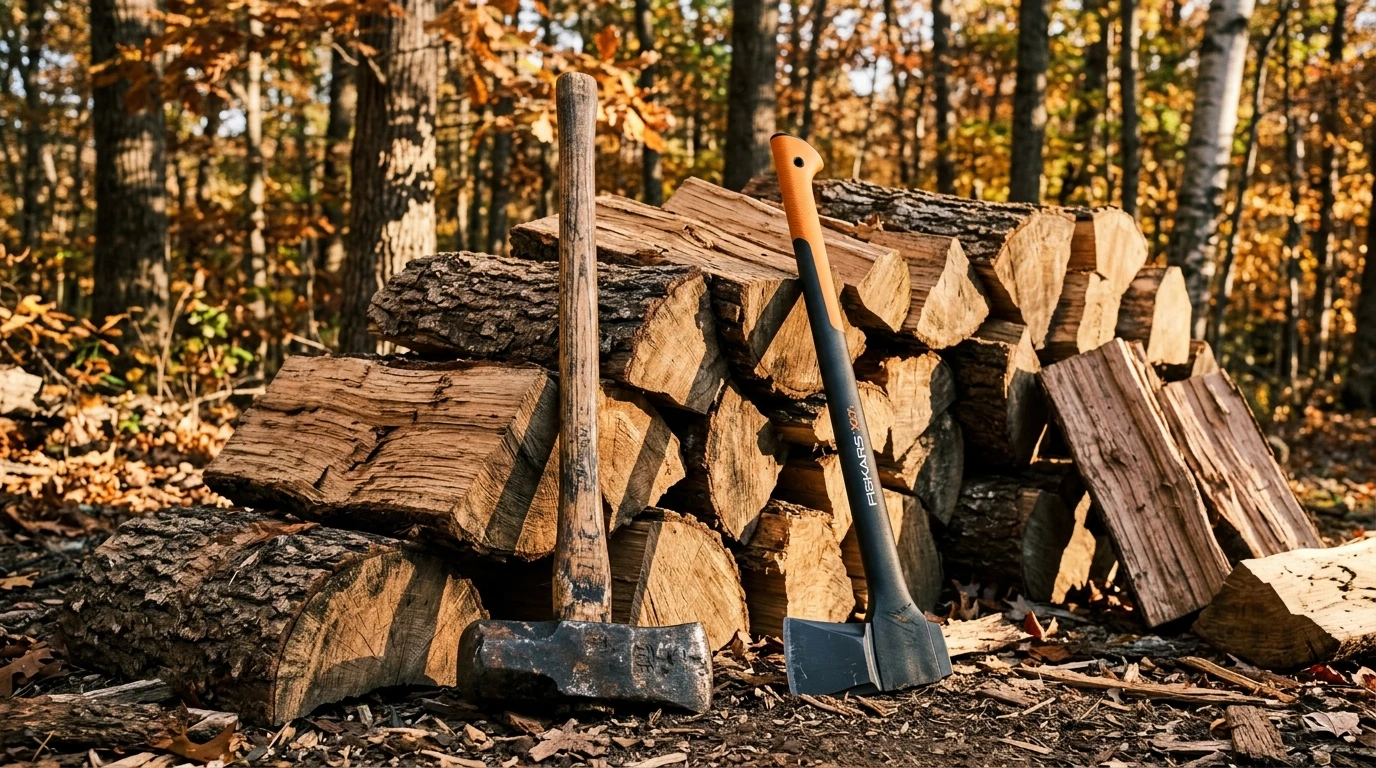
Wood splitting axes and heavy sledge mauls deliver high kinetic splitting force through wedge-flare geometry. High-velocity splitting axes (4.4 lbs, 36") burst straight grain via swing speed, while 6 to 8 lb mauls penetrate gnarly hardwood rounds through raw inertial mass.
The fundamental distinction between a wood splitting axe and a sledge maul lies in the physics of mechanical cleavage. A splitting axe combines a relatively sharp cutting edge (28°–32° bevel) with rapidly flaring convex cheeks. It relies on explosive swing velocity (v) to inject shock waves into radial growth rings. By contrast, a heavy sledge maul features a blunt 45°–50° face designed to deliver brute inertial momentum (p = m × v). For whole-body ergonomics and reach calculations, see our master axe and tool sizing engine.
Overstrikes with heavy mauls frequently shatter wooden handles if struck below the eye. Always install a thick leather overstrike collar, or learn essential repair protocols in our guide to overstrike damage repair and handle re-hanging. For light campfire kindling, a maul is dangerously unwieldy; equip yourself with compact camp hatchets and pack tools instead.
Interactive Splitting Kinetic Energy Simulator & Fiskars X-Series Spec Matrix
Our kinetic simulator above calculates exact Joules and momentum vectors across 5 standard timber tools. Notice how the Fiskars X27 achieves 196 Joules through athletic swing speed, while the 8 lb maul delivers 36.3 kg·m/s of momentum through unyielding head mass.
High-Velocity Wedge Physics (Fiskars X27) vs. 8 lb Sledge Maul Inertial Cleavage
The Fiskars X27 revolutionized modern firewood processing by proving that light total weight coupled with a proprietary friction-reducing PTFE bit coating outperforms raw muscle. Because kinetic energy quadruples when swing speed doubles, a fit operator swinging an X27 at 14 to 16 m/s achieves higher initial fracture energy than an exhausted operator lumbering with an 8-pound sledge maul at 9 m/s.
However, when wood fibers are twisted, knotty, or cross-grained, high speed alone cannot overcome friction. If the blade does not burst the round on first impact, a light axe bounces or lodges, requiring frustrating extraction effort. Here, the sheer downward momentum of an 8 lb sledge maul crushes through cross-grain knots where lighter axes stall.
Tackling Difficult Hardwoods: Seasoned Red Oak, Interlocked Elm & Knotted Sweetgum
Northern Red Oak (Quercus rubra)
With a Janka hardness of 1,290 lbf and prominent radial medullary rays, Red Oak splits predictably when struck from the top round. The key is allowing green logs to cure or splitting them below freezing, where frozen sap accelerates radial fracturing. A high-velocity wedge like the Fiskars X27 or 6 lb maul splits standard 16" rounds in a single center or chord strike.
American Elm (Ulmus americana)
Elm features a helical, alternating spiral grain structure that weaves together like braided rope. Striking directly into the heartwood will bury a thin splitting axe and lock the head tight. The proven tactical protocol requires "noodling" with a chainsaw or peeling perimeter slabs ("slabbing") with an 8 lb sledge maul and paired diamond wedges before attacking the core.
Sweetgum (Liquidambar styraciflua)
Sweetgum exhibits interlocked cellular fibers that resist wedge cleavage even when completely dry. Never attempt to split sweetgum logs with a lightweight camping axe or boys axe. Place logs on a stable chopping block and drive an 8 lb maul around the outer 2 inches of the circumference, systematically chipping away slabs rather than attempting to halve the trunk.
Frequently Asked Questions About Splitting Axes, Mauls & Fiskars Tools
01 Why is a splitting axe better than a maul for standard firewood?
A splitting axe like the Fiskars X27 weighs just 4.4 lbs total, allowing an operator to swing at 14 m/s and generate nearly 200 Joules of kinetic bursting shock. Because it causes far less physical exhaustion than swinging an 8 lb sledge maul, users can process twice the cordwood volume per hour on straight-grained logs under 16 inches in diameter.
02 Can I hit a splitting axe with a sledgehammer?
Never strike the poll of a standard splitting axe with a steel sledgehammer. Standard axe polls are left unhardened to absorb impact; striking them with hardened steel causes the eye to deform, permanently ruining handle fit, and risks flaking dangerous steel shrapnel. Only heavy mauls specifically designated as 'sledge mauls' feature hardened polls rated for striking wedges.
03 When is an 8-pound sledge maul strictly required?
An 8 lb maul is required when tackling rounds over 18 inches in diameter, crotches, stump cuts, or woods with interlocked helical grain like American Elm and Sweetgum. The blunt 45° wedge profile and massive linear momentum (36+ kg·m/s) prevents the head from bouncing, driving deep into stubborn grain.
04 How does the Fiskars IsoCore 8 lb Maul differ from traditional hickory mauls?
The IsoCore 8 lb maul integrates a patented shock-absorbing collar that insulates the operator from up to 70% of impact vibrations compared to traditional wood or fiberglass hafts, drastically reducing forearm tendonitis and wrist fatigue during heavy cords.